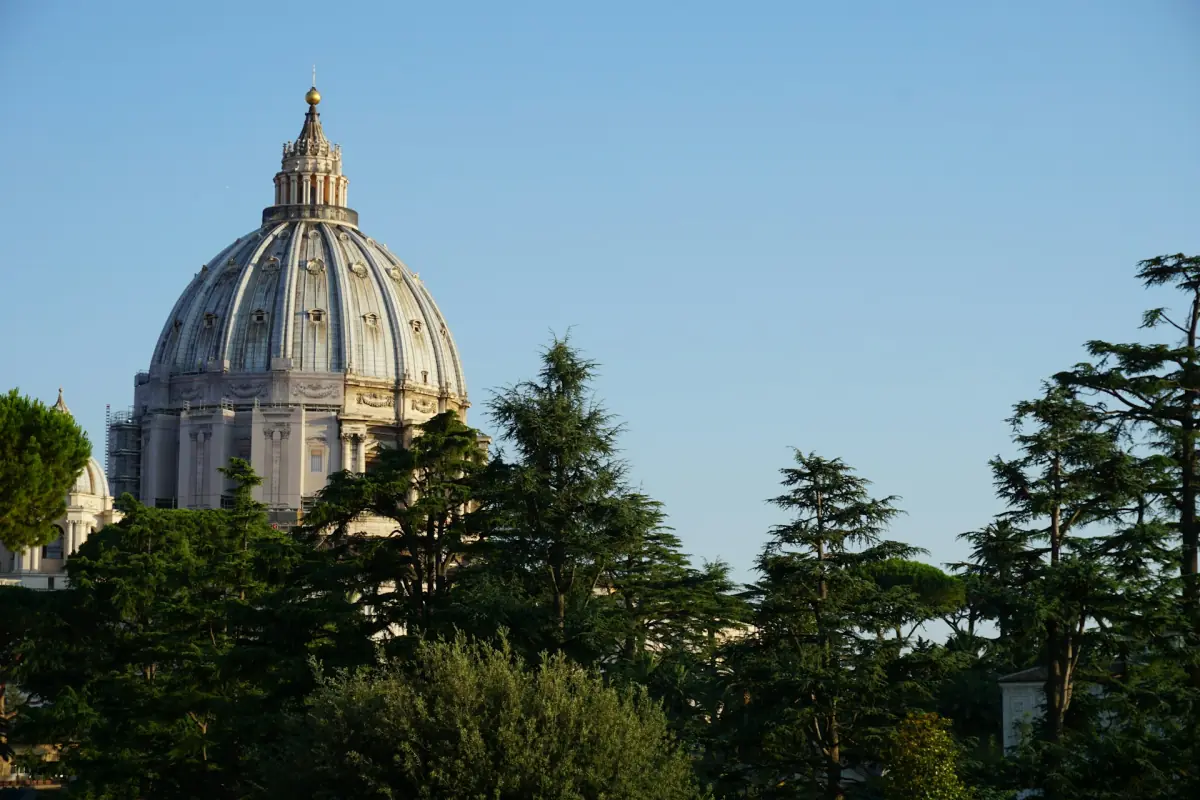
Michelangelo's design for the dome of St Peter's Basilica
Michelangelo designed the dome of St Peter's Basilica and brought construction as far as the drum, the part immediately below the curved vault. Looking at the building from outside, find the base of the curve first. The drum sits below it and gives you a way to pick out where Michelangelo's work on the building had reached.
St Peter's Dome is a work of Renaissance architecture built in successive stages. The drum, the vault and the lantern each tell a different part of that story. From St Peter's Square, follow the profile from the drum up the ribs to the lantern. From the inner ring during the dome climb, you can look into the basilica and see the dome as part of the interior.
The dome rises high above the roof of the basilica. Its silhouette makes the stages easy to trace from ground level, even if you plan to spend your time in the church.

See the dome on a guided visit
An English-speaking guide accompanies this small-group visit to the dome and basilica.
Hand-picked tours, booked through Viator. Prices are indicative starting prices in euros (as of November 2026). Tap a tour for live availability and the current price in your currency.

Visit St Peter's Dome with a guide
An English-speaking guide leads this shared visit to the dome and basilica for up to ten participants. Dome admission and a lift for part of the climb are included.
How the vault and lantern were completed
Giacomo della Porta and Domenico Fontana completed the vault of St Peter's Dome in 1590, after working on it from 1588. Michelangelo died in 1564, before the vault was completed. His work on the drum and the later work on the vault can be read together in the outline of the building.
The finishing work on the lantern continued after the vault was complete. On 18 November 1593, the gilded bronze orb and cross made by Sebastiano Torrigiani were set in place. When looking up from the square, trace the broad curve first and then the narrower lantern and its crowning pieces. The dates mark the completion of the main vault and the later addition at the summit.
The double dome and the stairs between its shells
St Peter's Dome has an outer shell that protects the inner shell, with a passage between them. The stairs above the terrace run through that space to the upper outdoor ring. You can see the inside curve from the inner ring and experience the gap between the shells on the upper stairs. The lantern rises above the outer ring, with the orb and cross higher still.
If you want to see the construction from the visitor route, use the dome ticket guide to choose between stairs and lift to terrace level. The church itself is free to enter for an ordinary visit, and the dome requires its own ticket. To go with a guide, compare the dome tours. The English-language small group visit starts at Borgo Pio 136 and includes early entrance to the basilica.
The upper ring lies 320 steps above the terrace and is unsuitable for wheelchair users. The climb is discouraged during pregnancy and for visitors with heart or breathing problems, vertigo, claustrophobia or limited mobility. The direct stair offer is recommended from age six, with an accompanying adult required through age 17. If the stairs are too demanding, you can study the dome from the church and the square.

Questions about the history of St Peter's Dome
Did Michelangelo finish the dome?
No, Michelangelo designed the dome of St Peter's Basilica and construction under him reached the drum. Giacomo della Porta and Domenico Fontana carried on the work and completed the vault in 1590. The orb and cross went on top of the lantern in 1593.
When was the vault finished?
1590 was the year Giacomo della Porta and Domenico Fontana completed the vault of St Peter's Dome. The gilded bronze orb and cross were set in place in 1593. From the square you can pick out the wide curve of the vault below the lantern.
Where can you see how the double dome works?
The upper staircase of St Peter's Dome takes you between its two shells. The inner ring shows the curve above the church, and the route above the terrace takes you through the space between the inner and outer surfaces before you step onto the upper outdoor ring.